Quick read
MONK protects private space with almost spiritual seriousness. Distance is not coldness so much as architecture: a clean perimeter that keeps the inner world breathable and uncluttered.
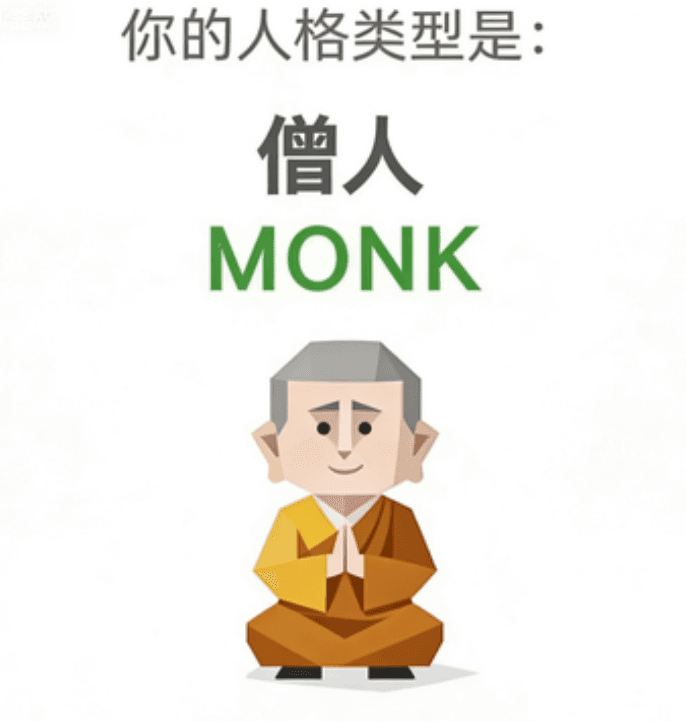
No worldly cravings here.
Quick read
MONK protects private space with almost spiritual seriousness. Distance is not coldness so much as architecture: a clean perimeter that keeps the inner world breathable and uncluttered.
Type guide
MONK (The Monk) is a standard SBTI personality result. Instead of stopping at the label, this page explains how the type tends to read across self-image, attachment, worldview, action style, and social behavior so the landing page answers real search intent instead of just naming the meme.
Why this match happens
People often arrive at MONK because their answers stack up in a recognizable combination: S1 Self-worth & Confidence high, S2 Self-clarity high, S3 Core Values low. In other words, this result usually comes from a pattern, not from one dramatic answer or one joke question.
Quick read
MONK protects private space with almost spiritual seriousness. Distance is not coldness so much as architecture: a clean perimeter that keeps the inner world breathable and uncluttered.
This type's 15-dimension fingerprint
Self Model
S1 Self-worth & Confidence
You usually carry a stable sense of worth, even when the room gets noisy.
Self Model
S2 Self-clarity
You have a clear enough read on your own temperament, needs, and limits.
Self Model
S3 Core Values
It is easy for life to feel like drift rather than direction.
Emotion Model
E1 Attachment Security
Small signals can make you brace for abandonment or betrayal.
Emotion Model
E2 Emotional Investment
You keep emotional investment on a shorter leash and rarely go all in.
Emotion Model
E3 Boundaries & Dependence
No matter how much you care, you still need a zone that stays yours.
Attitude Model
A1 Worldview Bias
You look at the world with more suspicion than innocence.
Attitude Model
A2 Rules & Flexibility
Rules feel negotiable, and improvisation often feels more alive.
Attitude Model
A3 Sense of Meaning
You are still figuring out what truly feels worth organizing your life around.
Action Model
Ac1 Motivational Direction
You balance caution and ambition depending on the context.
Action Model
Ac2 Decision Style
You can decide when needed, but not without some internal back-and-forth.
Action Model
Ac3 Execution Pattern
Plans often stay in your head longer than they stay in motion.
Social Model
So1 Social Initiative
You are less likely to approach first and more likely to wait and watch.
Social Model
So2 Interpersonal Boundaries
Your boundaries run strong, and your body notices intrusion fast.
Social Model
So3 Expression & Authenticity
You adjust your expression depending on the room, but not completely.
Five model groups
S1 · S2 · S3
Looks at how stable your self-evaluation is, whether you know yourself clearly, and whether something inside you truly matters. For MONK (The Monk), the recurring pattern usually reads: S1 Self-worth & Confidence runs high, S2 Self-clarity runs high, S3 Core Values runs low.
Self Model
S1 Self-worth & Confidence
You usually carry a stable sense of worth, even when the room gets noisy.
Self Model
S2 Self-clarity
You have a clear enough read on your own temperament, needs, and limits.
Self Model
S3 Core Values
It is easy for life to feel like drift rather than direction.
E1 · E2 · E3
Looks at whether you feel anxious or secure in relationships, how deeply you invest, and how much independence you need. For MONK (The Monk), the recurring pattern usually reads: E1 Attachment Security runs low, E2 Emotional Investment runs low, E3 Boundaries & Dependence runs high.
Emotion Model
E1 Attachment Security
Small signals can make you brace for abandonment or betrayal.
Emotion Model
E2 Emotional Investment
You keep emotional investment on a shorter leash and rarely go all in.
Emotion Model
E3 Boundaries & Dependence
No matter how much you care, you still need a zone that stays yours.
A1 · A2 · A3
Looks at how you see the world, rules, and meaning: cautious and orderly, or flexible and impulsive. For MONK (The Monk), the recurring pattern usually reads: A1 Worldview Bias runs low, A2 Rules & Flexibility runs low, A3 Sense of Meaning runs mid-range.
Attitude Model
A1 Worldview Bias
You look at the world with more suspicion than innocence.
Attitude Model
A2 Rules & Flexibility
Rules feel negotiable, and improvisation often feels more alive.
Attitude Model
A3 Sense of Meaning
You are still figuring out what truly feels worth organizing your life around.
Ac1 · Ac2 · Ac3
Looks at whether you move toward growth or away from risk, how decisive you are, and whether your plans actually land. For MONK (The Monk), the recurring pattern usually reads: Ac1 Motivational Direction runs mid-range, Ac2 Decision Style runs mid-range, Ac3 Execution Pattern runs low.
Action Model
Ac1 Motivational Direction
You balance caution and ambition depending on the context.
Action Model
Ac2 Decision Style
You can decide when needed, but not without some internal back-and-forth.
Action Model
Ac3 Execution Pattern
Plans often stay in your head longer than they stay in motion.
So1 · So2 · So3
Looks at whether you approach people actively, how strong your boundaries are, and how authentic you stay across relationships. For MONK (The Monk), the recurring pattern usually reads: So1 Social Initiative runs low, So2 Interpersonal Boundaries runs high, So3 Expression & Authenticity runs mid-range.
Social Model
So1 Social Initiative
You are less likely to approach first and more likely to wait and watch.
Social Model
So2 Interpersonal Boundaries
Your boundaries run strong, and your body notices intrusion fast.
Social Model
So3 Expression & Authenticity
You adjust your expression depending on the room, but not completely.
Result FAQ
Result FAQ
MONK is one of the result labels in the SBTI personality test. It carries meme energy, but it also maps to a more stable behavioral pattern, which is why this page explains both the joke layer and the useful personality read.
Result FAQ
People often arrive at MONK because their answers stack up in a recognizable combination: S1 Self-worth & Confidence high, S2 Self-clarity high, S3 Core Values low. In other words, this result usually comes from a pattern, not from one dramatic answer or one joke question.
Result FAQ
MONK is best read as the closest SBTI personality match for this test run, not as a lifelong sentence carved in stone.
Result FAQ
If you want to compare nearby personalities, start with IMSB (The Self-Roaster), SOLO (The Loner), FUCK (The Wild One). They are usually more useful comparison pages than random distant types.
Compare More
Keep browsing
More Entry Points
More Entry Points
Jump straight into the sbti test and get your personality result.
More Entry Points
Use the full directory to compare every result page in one place.
More Entry Points
Read the test logic, five model groups, and result-page guide.
More Entry Points
Continue into the sitewide distribution and leaderboard preview page.