Quick read
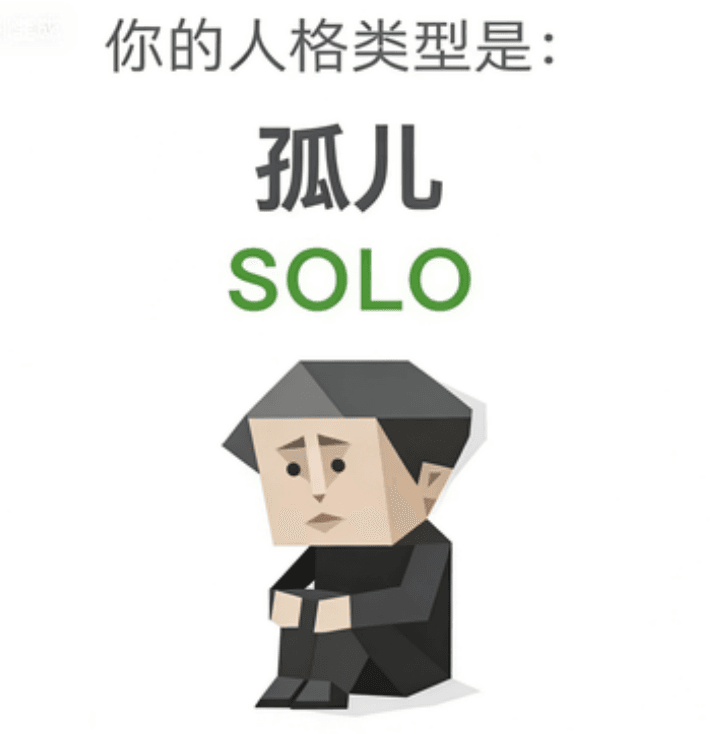
SOLO wants closeness but often builds distance first, usually in self-defense. The walls can look hostile from the outside, but many of them were poured around old tenderness rather than around contempt.
I'm crying. How did I end up as the loner?
Quick read
SOLO wants closeness but often builds distance first, usually in self-defense. The walls can look hostile from the outside, but many of them were poured around old tenderness rather than around contempt.
Type guide
SOLO is one of the most misunderstood SBTI results. On the surface, it looks like low social need, emotional distance, and a preference for being left alone. But what gives the page its real depth is that SOLO often isn't about not wanting closeness. It's about wanting closeness while distrusting what closeness might cost.
Why this match happens
People often land on SOLO when their answers show withdrawal, self-protection, and social hesitation at the same time. You may not reject intimacy outright, but you tend to build distance early so you don't get emotionally exposed before the situation feels safe.
Quick read
SOLO wants closeness but often builds distance first, usually in self-defense. The walls can look hostile from the outside, but many of them were poured around old tenderness rather than around contempt.
This type's 15-dimension fingerprint
Self Model
S1 Self-worth & Confidence
You are harder on yourself than most people are, and praise rarely lands cleanly.
Self Model
S2 Self-clarity
You know parts of yourself well, but not everything lines up yet.
Self Model
S3 Core Values
It is easy for life to feel like drift rather than direction.
Emotion Model
E1 Attachment Security
Small signals can make you brace for abandonment or betrayal.
Emotion Model
E2 Emotional Investment
You keep emotional investment on a shorter leash and rarely go all in.
Emotion Model
E3 Boundaries & Dependence
No matter how much you care, you still need a zone that stays yours.
Attitude Model
A1 Worldview Bias
You look at the world with more suspicion than innocence.
Attitude Model
A2 Rules & Flexibility
Order matters to you, and chaos is rarely your first choice.
Attitude Model
A3 Sense of Meaning
Life can feel random, mechanical, or stripped of larger meaning.
Action Model
Ac1 Motivational Direction
Avoiding damage often comes before chasing gains.
Action Model
Ac2 Decision Style
You can decide when needed, but not without some internal back-and-forth.
Action Model
Ac3 Execution Pattern
Plans often stay in your head longer than they stay in motion.
Social Model
So1 Social Initiative
You are less likely to approach first and more likely to wait and watch.
Social Model
So2 Interpersonal Boundaries
Your boundaries run strong, and your body notices intrusion fast.
Social Model
So3 Expression & Authenticity
You adjust your expression depending on the room, but not completely.
Five model groups
S1 · S2 · S3
Looks at how stable your self-evaluation is, whether you know yourself clearly, and whether something inside you truly matters. For SOLO (The Loner), the recurring pattern usually reads: S1 Self-worth & Confidence runs low, S2 Self-clarity runs mid-range, S3 Core Values runs low.
Self Model
S1 Self-worth & Confidence
You are harder on yourself than most people are, and praise rarely lands cleanly.
Self Model
S2 Self-clarity
You know parts of yourself well, but not everything lines up yet.
Self Model
S3 Core Values
It is easy for life to feel like drift rather than direction.
E1 · E2 · E3
Looks at whether you feel anxious or secure in relationships, how deeply you invest, and how much independence you need. For SOLO (The Loner), the recurring pattern usually reads: E1 Attachment Security runs low, E2 Emotional Investment runs low, E3 Boundaries & Dependence runs high.
Emotion Model
E1 Attachment Security
Small signals can make you brace for abandonment or betrayal.
Emotion Model
E2 Emotional Investment
You keep emotional investment on a shorter leash and rarely go all in.
Emotion Model
E3 Boundaries & Dependence
No matter how much you care, you still need a zone that stays yours.
A1 · A2 · A3
Looks at how you see the world, rules, and meaning: cautious and orderly, or flexible and impulsive. For SOLO (The Loner), the recurring pattern usually reads: A1 Worldview Bias runs low, A2 Rules & Flexibility runs high, A3 Sense of Meaning runs low.
Attitude Model
A1 Worldview Bias
You look at the world with more suspicion than innocence.
Attitude Model
A2 Rules & Flexibility
Order matters to you, and chaos is rarely your first choice.
Attitude Model
A3 Sense of Meaning
Life can feel random, mechanical, or stripped of larger meaning.
Ac1 · Ac2 · Ac3
Looks at whether you move toward growth or away from risk, how decisive you are, and whether your plans actually land. For SOLO (The Loner), the recurring pattern usually reads: Ac1 Motivational Direction runs low, Ac2 Decision Style runs mid-range, Ac3 Execution Pattern runs low.
Action Model
Ac1 Motivational Direction
Avoiding damage often comes before chasing gains.
Action Model
Ac2 Decision Style
You can decide when needed, but not without some internal back-and-forth.
Action Model
Ac3 Execution Pattern
Plans often stay in your head longer than they stay in motion.
So1 · So2 · So3
Looks at whether you approach people actively, how strong your boundaries are, and how authentic you stay across relationships. For SOLO (The Loner), the recurring pattern usually reads: So1 Social Initiative runs low, So2 Interpersonal Boundaries runs high, So3 Expression & Authenticity runs mid-range.
Social Model
So1 Social Initiative
You are less likely to approach first and more likely to wait and watch.
Social Model
So2 Interpersonal Boundaries
Your boundaries run strong, and your body notices intrusion fast.
Social Model
So3 Expression & Authenticity
You adjust your expression depending on the room, but not completely.
Result FAQ
Result FAQ
Not really. SOLO is better understood as defensive distance, not simple disinterest in people. Many SOLO personalities still want connection; they just approach it cautiously.
Result FAQ
Because it names a familiar contradiction: wanting to be understood while reflexively stepping back before the relationship gets too close or too unpredictable.
Result FAQ
MONK looks more intentionally detached and self-contained. SOLO feels more like emotionally loaded withdrawal: distance with longing still inside it.
Result FAQ
Watch how early and how strongly you activate protective distance. The deeper issue is often not social skill, but the nervousness of letting closeness begin.
Compare More
Keep browsing
More Entry Points
More Entry Points
Jump straight into the sbti test and get your personality result.
More Entry Points
Use the full directory to compare every result page in one place.
More Entry Points
Read the test logic, five model groups, and result-page guide.
More Entry Points
Continue into the sitewide distribution and leaderboard preview page.