Quick read
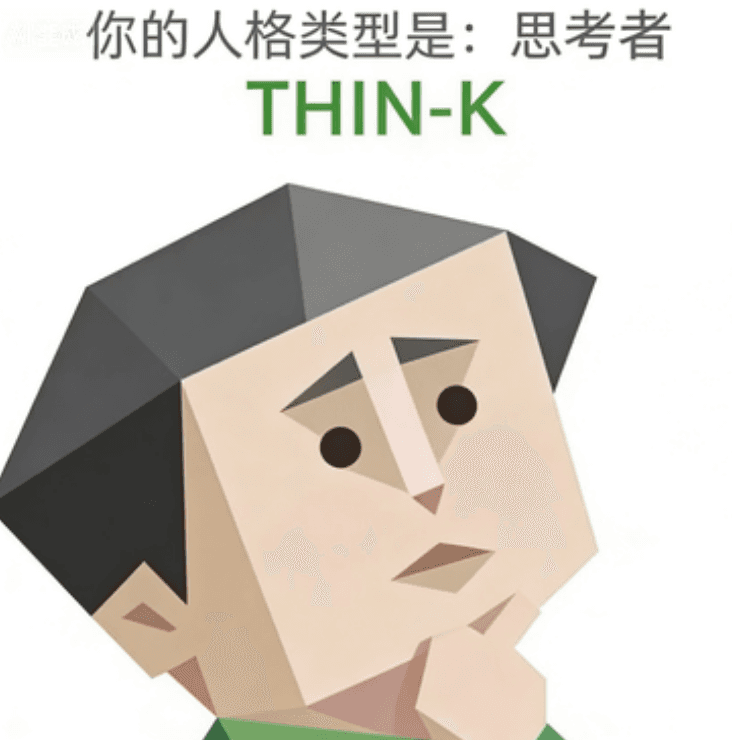
THIN-K rarely accepts information at face value. Claims, motives, blind spots, logic gaps, and hidden costs all get dragged under the desk lamp for inspection before trust is granted.
Deep-thinking session: 100 seconds and counting.
Quick read
THIN-K rarely accepts information at face value. Claims, motives, blind spots, logic gaps, and hidden costs all get dragged under the desk lamp for inspection before trust is granted.
Type guide
THIN-K is the SBTI result people often search for when they suspect they are overthinking, hyper-analytical, or mentally impossible to switch off. The type isn't just 'smart' and it isn't just 'anxious' either. Its defining move is that it refuses to take information at face value and keeps pulling reality back under the lamp for one more inspection.
Why this match happens
People often land on THIN-K when their worldview, decision style, and action pattern all lean toward analysis, caution, and delayed commitment. In practice, that means your mind often runs an internal review process before your body agrees to move.
Quick read
THIN-K rarely accepts information at face value. Claims, motives, blind spots, logic gaps, and hidden costs all get dragged under the desk lamp for inspection before trust is granted.
This type's 15-dimension fingerprint
Self Model
S1 Self-worth & Confidence
You usually carry a stable sense of worth, even when the room gets noisy.
Self Model
S2 Self-clarity
You have a clear enough read on your own temperament, needs, and limits.
Self Model
S3 Core Values
It is easy for life to feel like drift rather than direction.
Emotion Model
E1 Attachment Security
You are more willing to trust the bond itself and less likely to panic over tiny shifts.
Emotion Model
E2 Emotional Investment
You do invest, just with one eye still on the exit.
Emotion Model
E3 Boundaries & Dependence
No matter how much you care, you still need a zone that stays yours.
Attitude Model
A1 Worldview Bias
You are neither naive nor fully cynical; you watch first.
Attitude Model
A2 Rules & Flexibility
Rules feel negotiable, and improvisation often feels more alive.
Attitude Model
A3 Sense of Meaning
You move with more direction and usually know roughly where you are trying to go.
Action Model
Ac1 Motivational Direction
You balance caution and ambition depending on the context.
Action Model
Ac2 Decision Style
You decide quickly and dislike revisiting the same choice again and again.
Action Model
Ac3 Execution Pattern
Execution comes in waves rather than as a constant force.
Social Model
So1 Social Initiative
You are less likely to approach first and more likely to wait and watch.
Social Model
So2 Interpersonal Boundaries
Your boundaries run strong, and your body notices intrusion fast.
Social Model
So3 Expression & Authenticity
You filter yourself more carefully and are less likely to reveal the whole interior at once.
Five model groups
S1 · S2 · S3
Looks at how stable your self-evaluation is, whether you know yourself clearly, and whether something inside you truly matters. For THIN-K (The Thinker), the recurring pattern usually reads: S1 Self-worth & Confidence runs high, S2 Self-clarity runs high, S3 Core Values runs low.
Self Model
S1 Self-worth & Confidence
You usually carry a stable sense of worth, even when the room gets noisy.
Self Model
S2 Self-clarity
You have a clear enough read on your own temperament, needs, and limits.
Self Model
S3 Core Values
It is easy for life to feel like drift rather than direction.
E1 · E2 · E3
Looks at whether you feel anxious or secure in relationships, how deeply you invest, and how much independence you need. For THIN-K (The Thinker), the recurring pattern usually reads: E1 Attachment Security runs high, E2 Emotional Investment runs mid-range, E3 Boundaries & Dependence runs high.
Emotion Model
E1 Attachment Security
You are more willing to trust the bond itself and less likely to panic over tiny shifts.
Emotion Model
E2 Emotional Investment
You do invest, just with one eye still on the exit.
Emotion Model
E3 Boundaries & Dependence
No matter how much you care, you still need a zone that stays yours.
A1 · A2 · A3
Looks at how you see the world, rules, and meaning: cautious and orderly, or flexible and impulsive. For THIN-K (The Thinker), the recurring pattern usually reads: A1 Worldview Bias runs mid-range, A2 Rules & Flexibility runs low, A3 Sense of Meaning runs high.
Attitude Model
A1 Worldview Bias
You are neither naive nor fully cynical; you watch first.
Attitude Model
A2 Rules & Flexibility
Rules feel negotiable, and improvisation often feels more alive.
Attitude Model
A3 Sense of Meaning
You move with more direction and usually know roughly where you are trying to go.
Ac1 · Ac2 · Ac3
Looks at whether you move toward growth or away from risk, how decisive you are, and whether your plans actually land. For THIN-K (The Thinker), the recurring pattern usually reads: Ac1 Motivational Direction runs mid-range, Ac2 Decision Style runs high, Ac3 Execution Pattern runs mid-range.
Action Model
Ac1 Motivational Direction
You balance caution and ambition depending on the context.
Action Model
Ac2 Decision Style
You decide quickly and dislike revisiting the same choice again and again.
Action Model
Ac3 Execution Pattern
Execution comes in waves rather than as a constant force.
So1 · So2 · So3
Looks at whether you approach people actively, how strong your boundaries are, and how authentic you stay across relationships. For THIN-K (The Thinker), the recurring pattern usually reads: So1 Social Initiative runs low, So2 Interpersonal Boundaries runs high, So3 Expression & Authenticity runs high.
Social Model
So1 Social Initiative
You are less likely to approach first and more likely to wait and watch.
Social Model
So2 Interpersonal Boundaries
Your boundaries run strong, and your body notices intrusion fast.
Social Model
So3 Expression & Authenticity
You filter yourself more carefully and are less likely to reveal the whole interior at once.
Result FAQ
Result FAQ
Overthinking can be pure anxiety. THIN-K is more structured than that. It actively looks for logic gaps, motives, hidden costs, and weak assumptions.
Result FAQ
Because analysis consumes the action window. By the time your mind feels satisfied, the moment to move may already feel smaller or riskier.
Result FAQ
There can be overlap, but the center is different. OH-NO predicts threat, CTRL restores order, and THIN-K interrogates the structure before deciding whether the situation deserves belief.
Result FAQ
Spotting weak reasoning, hidden liabilities, and rhetorical shortcuts. In any environment that rewards judgment, this personality can be unusually useful.
Compare More
Keep browsing
More Entry Points
More Entry Points
Jump straight into the sbti test and get your personality result.
More Entry Points
Use the full directory to compare every result page in one place.
More Entry Points
Read the test logic, five model groups, and result-page guide.
More Entry Points
Continue into the sitewide distribution and leaderboard preview page.